European health Partnerships and Brussels stakeholders: are you eligible?
Article sections:
What are EU Partnerships?
What are the EU Health Partnerships ?
How does it work in Belgium?
Which Brussels entities can participate to the call launched by the EU Partnerships?
What are the current or foreseen open calls (as September 2025)?
How can NCP Brussels help?
What are EU Partnerships?
In Horizon Europe, they are collaborative strategic instruments in specific domains addressing European challenges. By collaborative, one should understand that they bring together the European Commission as well as public partners (such as national authorities or funding bodies, EU associations, research institutes or infrastructures) and/or private ones (such as industry). By strategic, one should understand that they are based on a long-term vision (10 years or more). By instruments, one should understand that an umbrella of activities or programmes will be implemented.
Basically, European Partnerships organise research and innovation activities, and as such strive to position Europe as a global leader in their respective fields by fostering multidisciplinary and international collaborative research.
These partnerships usually develop Strategic Research and Innovation Agendas (SRIAs), which define what should be funded and done, how, and when. They are created in consultation with key stakeholders and form the foundation of the activities Partnerships will implement over their lifespan (activities such as capacity building or the launch of transnational calls).
They all have specific missions, objectives, and rather complex governance structures, considering the variety of partners involved.
Partnerships usually have in common that they:
- launch transnational calls (and sometimes clinical studies),
- follow the FAIR principles,
- engage with different stakeholders (ranging from patients to industry),
- organise capacity-building activities.
Ultimately, they aim to create value for patients and healthcare systems.
Setting up partnerships can take years and usually arises from a bottom-up approach through multinational stakeholder engagement activities. There are different types of partnerships, differing by their legal basis, leadership, and complexity.
There are three types of partnerships (see the image below).
The most common partnerships in health are the co-funded ones (there are eight of them). As the name suggests, they are partly funded by the European Commission (usually between 30 and 50%) and partly by different national or regional funding bodies and implemented through Horizon Europe Grant Agreements (you’ll find these call topics under the “Co-Fund” action type in the Work Programme). In the early phases of their setup, the Commission supports their development through Coordination and Support Actions. These projects lay the groundwork for starting a partnership and running its implementation phase, tackling issues such as who will do what, how activities will be funded (e.g. which country or region in Belgium will contribute financially), and what the priorities will be. This requires considerable negotiation at the national level (or with private partners) and then with the Commission to decide how much the EC will contribute and what the nature and legal framework of the collaboration will be.
Another type of partnership is the institutionalised ones. Usually established with private partners, but sometimes also with public ones, they require a high degree of integration (and the adoption of specific legislation).
The last type is the co-programmed Partnerships. This is another form of collaboration between the European Commission and partners such as industry, universities, and research organisations. After agreeing on a strategic plan, the EU and partners work in parallel. They don’t pool their money in the same envelope but coordinate efforts and funding towards common objectives.
If you want to learn more about EU partnerships—whether you are a researcher, a network coordinator, or working at policy level—you can visit the ERA-LEARN website. This EU-funded project provides general information on Partnerships.
What are the EU Health Partnerships ?
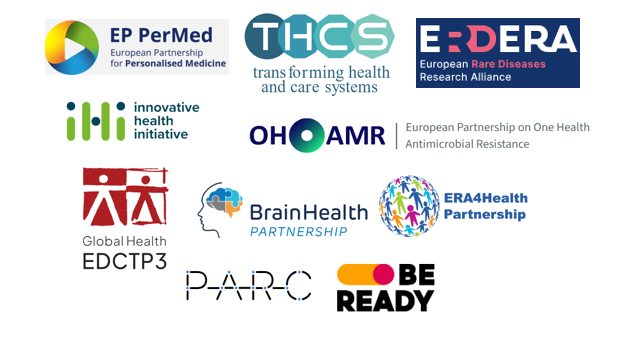
There are 6 established health EU Partnerships and two in the making.
- European and Developing Countries Clinical Trials Partnership, EDCTP3 (since 2021)
EDCTP is a public-private partnership between countries in Europe and sub-Saharan Africa, supported by the EU. It funds research for medical tools to detect, treat, and prevent poverty-related infectious diseases in sub-Saharan Africa.
- Innovative Health Medicine, IHI (since 2021)
IHI is a partnership for health research and innovation between the EU and Europe’s life science industries. It covers the entire continuum of care, from prevention and diagnostics to treatment and disease management. IHI is the successor of the Innovative Medicines Initiative (IMI), the world’s largest public-private collaboration in life sciences.
- European Rare Diseases Research Alliance, ERDERA, (1st Phase 2024 & 2nd Phase 2027)
ERDERA supports concrete health benefits to rare diseases patients through improved prevention, diagnosis and treatment. ERDERA roadmap has five interconnected routes to success: 1. Generates knowledge and translates it into medical interventions (e.g. funding for innovation, clinical trials); 2. Makes data work for science, regulation and care (e.g. work with research infrastructures); 3. Empowers people living with rare diseases as equal partners (e.g. patient engagement, training and mentoring); 4. Strengthens skills and capacity across Europe (e.g. launch competitive calls or education programmes); 5. Builds a truly integrated, pan-European ecosystem (e.g. deeper involvement of industry, regulators and payers alongside researchers and patients).
Their funding strategy is built on several types of calls:
- Joint Transnational Calls
- Clinical Trials Calls
- Networking Support Scheme
- European Partnership on Transforming Health and Care Systems, THCS (since 2023)
The objective is to contribute to the transition towards more sustainable, efficient, resilient, inclusive, innovative and high-quality people-centered health and care systems equally accessible to all people. They launch transnational R&I call every year and support coordinated activities such as capacity building, networking and dissemination.
- European Partnership for Personalised Medicine (EP PerMed) (2023-2033)
EP PerMed acts as a coordination platform bringing together international, national and regional ministries and funding organisations, agencies and authorities. 85% of the total resources will be used to support 3rd parties. It focuses on translating basic research into clinical practice, integrating big data and digital health, and strengthening the healthcare industry to speed up innovation uptake. It also builds a supportive ecosystem, ensures broad access to personalized medicine. It supports R&I activities via transnational calls and develops guidance and tools for effective deployment.
- European Partnership on One Health Antimicrobial Resistance, OHAMR (since 2025)
Its main goal is to contribute to achieving the objectives of the European One Health Action Plan against AMR and the WHO Global Action Plan on AMR, both aimed at reducing the threat of antimicrobial resistance (AMR). The expected impacts are:
- Novel solutions to prevent and treat infectious diseases affected by AMR, improved diagnosis and control of the spread of resistant microorganisms, testing and validation of such solutions and facilitating their uptake or implementation.
- Decreased burden of infectious diseases
- Closed knowledge gaps on AMR, support provided to regulatory science and inform policymaking.
- ERA for Health Research, ERA4Health (1st Phase 2023 & 2nd Phase 2026)
ERA4Health focuses on tackling diseases and reducing disease burden. The ERA4Health objectives are to:
- Support relevant medical research including clinical fields and intervention areas (prevention, diagnosis, treatment).
- Improve the utilisation of existing health technologies in clinical practice.
- Build capacity, in particular in conducting Investigator Initiated Clinical Studies at EU scale.
- Implement and advance the practice of responsible research and innovation (RRI) across the breadth of the programme.
Previous Transnational calls launched focus on Brain & nutrition, cardiovascular diseases, nanomedicine.
- European Partnership for Brain Health (launched in 2026)
A call for proposals (European Partnership for Brain Health, HORIZON-HLTH-2025-02-DISEASE-01) closed on June 03, 2025. The partnership is expected to start in 2026. The Coordination and Support Action BrainHealth is laying the groundwork for launching this partnership, and structuring research and innovation in this area.
- European Partnership for Pandemic Preparedness (BE READY NOW), (2026-2032)
The Coordinated and Support Action Be Ready Plus, started in January 2025, is designed to help Europe better predict and respond to new infectious disease threats. To do so, this project is paving the way towards the launch and implementation of the pandemic preparedness EU partnership.
- European Partnership for the Assessment of Risk from Chemicals, PARC (since 2022)
A key objective of PARC is to promote European cooperation, advance research, increase knowledge of chemical risk assessment and train relevant methodological skills. The results will help launch European and national strategies to reduce risks posed by hazardous chemicals to health and the environment. Furthermore, they will help to reduce animal testing and implement strategies for next-generation risk assessment.
How does it work in Belgium?
Regarding the co-funded partnerships, each region and the Federal decide whether they will be part of the Partnership consortium as a partner and whether they will contribute to the common envelope funding the transnational calls. Indeed, regions have the competencies for research and innovation activities.
If your organisation is interested in contributing to such a type of partnership, don’t hesitate to contact your National Contact Points.
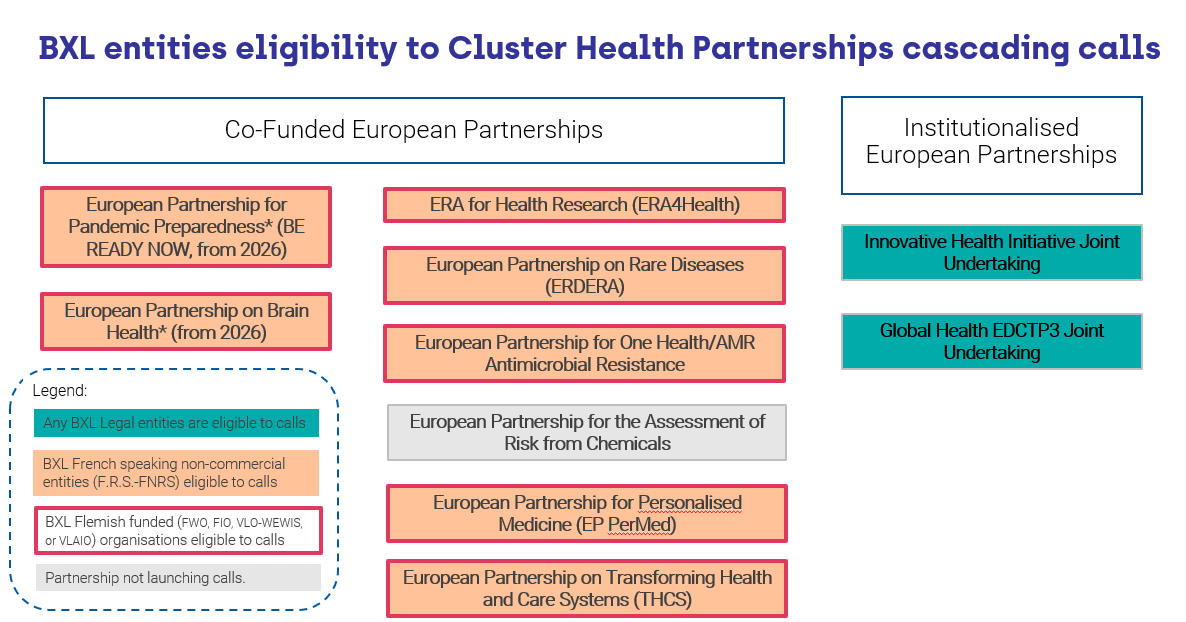
Which Brussels entities can participate to the call launched by the EU Partnerships?
|
Watch out! In the Work Programme of Cluster 1 (current or 2026–2027), one can find calls for proposals related to health partnerships. Their action type is “COFUND,” as they are co-funded by the Commission and by the Member States and their funding agencies. These calls usually target national funding bodies, public authorities, or infrastructures, to name a few. This funding supports these actors in setting up research and innovation activities in their respective fields. |
For IHI and EDCTP, the institutionalised Partnerships, it is easy: Brussels legal entities can participate and are eligible for funding.
When looking at calls launched by health Partnerships (except the institutionalised ones), you must remember the famous Belgian lasagna concept. It is not because Belgium is listed as a participant country that the Brussels entities can participate.
For the co-funded Partnerships, in general, Brussels-based entities can participate in transnational calls (cascading calls) when a Belgian organisation/funder is participating. But this may vary from call to call.
However, a Brussels-based entity can only receive funding if Brussels Region funders (to date FNRS or Innoviris) or Brussels university funded by the Flemish region are financially contributing to these calls.
Innoviris is not participating in any of them. The F.R.S.-FNRS participates in most of them, meaning that researchers affiliated with F.R.S.-FNRS can participate and get funding for transnational calls where F.R.S.-FNRS is a funder. The VUB, as funded by Flanders, is eligible to participate and get funding to European Partnership cascading calls/JTC where FWO is involved. (Note that for calls where only VLAIO is involved, VUB might not be eligible as VLAIO primarily funds businesses).
Importantly, SMEs, most of the Brussels hospitals (except University hospitals – CHUs) can therefore usually not participate and get funding.
Importantly, there are exceptions so it is essential to check the call details to know whether your organisation can participate.
Note: For some transnational calls, it may be possible to participate but not get any funding. This must be checked in the call documents when they are published.
Besides, for some calls, it may be possible to request funding from the Partnerships secretariat (rather than regional funders). It was the case in the past for calls where Patient Association Organisations were recommended to participate.
What are the current or foreseen open calls (as 2025.12.08)?
| Partnership Acronyme | Call | Call Timeline | Webinars and Brokerage Platforms | Belgium funders involved | Last update |
|
Institutionalized Partnerships |
|||||
| IHI | Call 12 Draft text here. | Official launch in Early 2026 | 19-20 January 2026 Call Days (upcoming call, including rules, procedures, financial aspects, and general information)
Register here. Brokerage platform here. |
25.11.2025 | |
| IHI | Call13 | Pre-publication of the two-stage Spring 2026. | 31.09.2025 | ||
| EDTCP3 | Work Programme 2026
In a nutshell: 4 Research and Innovation Actions (1. development of TB drug for therapy and chemoprophylaxis, 2. prevention/treatment of lower respiratory tract infections, 3. management of HIV co-infections, 4. climate and health) and 2 Coordination and Support Action (1. training and innovation network about ethics, regulatory and pharmacovigilance, 2. integrated research and healthcare through digital innovation and artificial intelligence). |
Info Day: 5 February 2026
Participants can simultaneously register for the networking platform |
2025.12.08 | ||
|
Co-funded Partnerships |
|||||
| EP PerMed | Test and Demonstration of Multimodal Data Approaches for Personalised Medicine (MultiPMData2026) | Deadline for pre-proposal: 12 January 2026
|
Online webinar recording: 28 October 2026
Matchmaking event: 18 November 2026 |
FIO VLAIO
SPW-EER |
2025.12.08
|
| EP PerMed
|
Fast Track Validation Programme 2026 | Deadline: 10 March 2026 | Introductory webinar for interested applicants: 20 January 2026
Final Q&A webinar: 03 March 2026 |
All Brussels entity eligible, including SME.
Solution must be at least TRL 3 |
2025.12.02 |
| EP PerMed | Joint Transnational Call 2026: Personalised Medicine for CARdiovascular, MEtabolic, and kidNey diseases (CARMEN2026) | Deadline for pre-proposal: 10 February 2026 | Information day: 16 December 2025 | F.R.S.-FNRS
FWO
|
2025.12.08
|
| ERDERA | Joint Transnational Call 2026 “Resolving unsolved cases in rare genetic and non‑genetic diseases”
|
Call opening: 10 December 2026
Deadline for pre-proposal: 12 February 2026
|
Information webinar: 16 December 2025 | F.R.S.-FNRS funding planned (TBC). Others to be announced.
|
2025.12.08
|
| ERDERA | Clinical Trials Call
|
Opening soon | No Belgium funder involved (TBC).
No F.R.S.-FNRS participation confirmed. |
2025.12.08
|
|
| ERDERA | Networking Support Scheme
|
Deadline: 7 April 2026 | Any Belgium entity. | 2025.12.08 | |
| OHAMR | Joint Transnational Call “New treatments to tackle Antimicrobial Resistance” | Deadline: 02 February 2026 | Webinar for applicants: 26 November 2025
Recording here
|
F.R.S.-FNRS
FWO SPW |
2025.12.08
|
| ERA4Health | Prevent-OO: Understanding and Preventing Overweight and Obesity – Mechanisms of their onset and progression, neglected determinants and novel strategies for critical transitional periods in life
|
Launch in 2025 | Webinar Indo Day presentation. | F.R.S.-FNRS
FWO
|
To update. |
| ERA4Health | Trials4Health: “Multi-country Investigator-Initiated Clinical Trials in Cardiovascular, Autoimmune and Metabolic diseases” | Deadline for pre-proposal subission; 27 Januray 2026. | Webinar Infoday recording and presentations. | KCE | 2025.12.08 |
| BrainHealth | Joint Transnational calls pre-announcement (Biological, social & environmental factors shaping brain health across the lifespan: 1. neurological, mental & sensory disorders; 2. neurodegenerative disorders) | Launch 08 January 2026. | F.R.S.-FNRS
FWO |
2025.12.08 | |
| BE READY | Joint Transnational call pre-announcement “BE READY: Advancing knowledge of host and pathogen dynamics to better combat emerging diseases.” | Launch in 2026 | SPW (TBC).
F.R.S.-FNRS FWO |
2025.12.08
|
|
| THCS | Joint Transnational call 2026 “Access to care” | Submission of Pre-Proposal: 2 February 2026 | Information Webinar: 10 December 2025 | F.R.S.-FNRS
|
2025.12.08
|
| THCS
|
Joint Transnational call 2026 Call for Experts | Application form: THCS JTC2026 Access to Care – Fill out form. | n.a. | 2025.12.08
|
|
How can NCP Brussels help?
Your health NCPs can support you when applying to the institutionalised partnerships (IHI and EDCTP3). For the Joint Transnational Calls where F.R.S.-FNRS is participating, your contact will be the International and Institutional Affairs of the FNRS (international@frs-fnrs.be).
If your institution is interested in lobbying/building the case for having the Brussels region involved in the funding of the partnerships, please contact your Health NCPs.
If you are an SME, we will support you as this is the mission of both hub.brussels and Enterprise Europe Network.
Where can I find information about future open calls launched by EU Partnerships?
For IHI and EDCTP, you will find the open calls both on the EU Funding & Tender Portal as well as on their websites.
For the co-funded ones, you can subscribe to their newsletters or the F.R.S-FNRS channels (website, newsletter, LinkedIn) We, Health Brussels NCPs, also promote calls via our newsletters (send us an email if you want to receive it).
Author: Marie-Elisabeth Colin, mecolin@hub.brussels, 2025.09.26, reviewed by Maxime Bonsir, Policy Officer for International and Institutional Affairs at the Fonds de la Recherche Scientifique (FRS-FNRS) with input from Sarah Stroobants, Health and Cancer Mission – JRC NCP, NCP Flanders. Table of calls updated on 2025.12.08.
Your Brussels Health NCPs, Emilie Fonck and Marie-Elisabeth Colin (efonck@hub.brussels; mecolin@hub.brussels).